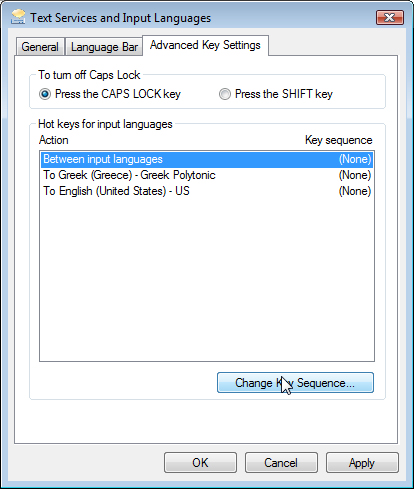
Having problems with your keyboard?How to change your default keyboard layout within Windows 7 and Windows Vista.This is a keyboard problem that a lot of non. Click Start, and go to Control Panel. Type ‘keyboard’ in the search box to the top right. In the ‘Regional and Language Options’ section, click ‘Change keyboard or other input methods’.
-->The following types of keyboards can cause a system crash directly:
PS/2 keyboards connected on i8042prt ports
This feature is available in Windows 2000 and later versions of Windows operating system.
USB keyboards
This feature is available in Windows Vista and later versions of Windows operating system.
Hyper-V keyboards
This feature is available in Windows 10 version 1903 and later versions of Windows operating system.
Configuration
Configure the following settings to enable the a system crash using keyboard:
If you wish a crash dump file to be written, you must enable such dump files, choose the path and file name, and select the size of the dump file. For more information, see Enabling a Kernel-Mode Dump File.
With PS/2 keyboards, you must enable the keyboard-initiated crash in the registry. In the registry key HKEY_LOCAL_MACHINESystemCurrentControlSetServicesi8042prtParameters, create a value named CrashOnCtrlScroll, and set it equal to a REG_DWORD value of 0x01.
With USB keyboards, you must enable the keyboard-initiated crash in the registry. In the registry key HKEY_LOCAL_MACHINESystemCurrentControlSetServiceskbdhidParameters, create a value named CrashOnCtrlScroll, and set it equal to a REG_DWORD value of 0x01.
With Hyper-V keyboards, you must enable the keyboard-initiated crash in the registry. In the registry key HKEY_LOCAL_MACHINESystemCurrentControlSetServiceshyperkbdParameters, create a value named CrashOnCtrlScroll, and set it equal to a REG_DWORD value of 0x01.
You must restart the system for these settings to take effect.
After this is completed, the keyboard crash can be initiated by using the following hotkey sequence: Hold down the rightmost CTRL key, and press the SCROLL LOCK key twice.
The system then calls KeBugCheck and issues bug check 0xE2 (MANUALLY_INITIATED_CRASH). Unless crash dumps have been disabled, a crash dump file is written at this point.
If a kernel debugger is attached to the crashed machine, the machine will break into the kernel debugger after the crash dump file has been written.
For more information on using this feature, refer to the article Windows feature lets you generate a memory dump file by using the keyboard.
Defining Alternate Keyboard Shortcuts to Force a System Crash from the Keyboard
You can configure values under the following registry subkeys for different keyboard shortcut sequences to generate the memory dump file:
For PS/2 keyboards:
HKEY_LOCAL_MACHINESYSTEMCurrentControlSetServicesi8042prtcrashdump
For USB keyboards:
HKEY_LOCAL_MACHINESYSTEMCurrentControlSetServiceskbdhidcrashdump
For Hyper-V keyboards:
HKEY_LOCAL_MACHINESYSTEMCurrentControlSetServiceshyperkbdcrashdump
You must create the following registry REG_DWORD values under these subkeys:
Dump1Keys
The Dump1Keys registry value is a bit map of the first hot key to use. For example, instead of using the rightmost CTRL key to initiate the hot key sequence, you can set the first hot key to be the leftmost SHIFT key.
Configure Your Keyboard Vista
The values for the first hot key are described in the following table.
| Value | First key used in the keyboard shortcut sequence |
|---|---|
0x01 | Rightmost SHIFT key |
0x02 | Rightmost CTRL key |
0x04 | Rightmost ALT key |
0x10 | Leftmost SHIFT key |
0x20 | Leftmost CTRL key |
0x40 | Leftmost ALT key |
Note You can assign Dump1Keys a value that enables one or more keys as the first key used in the keyboard shortcut sequence. For example, assign Dump1Keys a value of 0x11 to define both the rightmost and leftmost SHIFT keys as the first key in the keyboard shortcut sequence.
Dump2Key
The Dump2Key registry value is the index into the scancode table for the keyboard layout of the target computer. The following is the actual table in the driver.
Note Index 124 (sysreq) is a special case because an 84-key keyboard has a different scan code.
If you define alternate keyboard shortcuts to force a system crash from a USB or PS/2 keyboard, you must either set the CrashOnCtrlScroll registry value to 0 or remove it from the registry.
Limitations
It is possible for a system to freeze in such a way that the keyboard shortcut sequence will not work. However, this should be a very rare occurrence. Using the keyboard shortcut sequence to initiate a crash will work even in many instances where CTRL+ALT+DELETE does not work.
Forcing a system crash from the keyboard does not work if the computer stops responding at a high interrupt request level (IRQL). This limitation exists because the Kbdhid.sys driver, which allows the memory dump process to run, operates at a lower IRQL than the i8042prt.sys driver.
Function Keys, F1, F2, F3, F4, F5, F6, F7, F8, F9, F10, F11, F12
Configure Your Keyboard Vista Laptop
Every one of us has seen these 12 function keys on the Keyboard. But how many of us used these keys to have our jobs performed easier? These function keys perform different functions in different applications and programs. In combination with other keys these function keys perform different functions differently. For the benefit of all of us I have codified the ‘Function Keys’ performances.
As this information is collected from various web sites, magazines, some of them may prove wrong. I have tested most of them, and they are Ok. While collecting the information I have taken every care to collect correct information without ambiguity and I may have missed some, SO this is not the end.
F1
If you are in an application and you press this key, you will get its help file. Suppose you are not in Windows Explorer or Desktop, you press this key you will get Windows Help file. Suppose you are in an application, and you want windows help file, press windows key + F1, you will get windows help file. F1 + in combination with other keys:
SHIFT + F1 = Start context-sensitive help or reveal formatting (What is this? help)
ALT + F1 = Go to the next field
ALT + SHIFT + F1 = Go to the previous field
CTRL + ALT + F1 = Display Microsoft system information
For formatting characters and paragraphs:
CTRL + SHIFT + F1 = Change the font
F2
You select a program on your Desktop (icon) and press this key. You will be allowed to rename that program. The same function you can also perform by Right Clicking the mouse and in the resultant memo you will have the option to rename the program.
SHIFT + F2 = Copy Text
CTRL + F2 = Choose the print preview command (file menu)
ALT + SHIFT + F2 = Choose the save command (file menu)
CTRL + ALT + F2 = Choose the open command (file menu)
F3
While you are working in Windows Explorer or on Desktop, you press this key you will get the ‘Find Files’ window. You need not go to Start > find.
While you are working in MS Word (make your selection) and press
ALT + F3 = Create an auto text entry box appears.
SHIFT + F3 = Change the case of the letters.
F4
While you are in Internet Explorer and you will press this key the address bar will open.
If you want to close the selected window, press ALT + F4.
When no windows are open if you press ALT + F4, you will see the shut down screen. When no windows are open if you press ALT + F4, you will see the shut down screen.
When you are in MS Word, press
F4 = Repeat the last action
SHIFT + F4 = Repeat a Find or Go To action
CTRL + F4 = Close the Window
ALT + F4 = Quit the word program
F5
To refresh the active window in IE or WE, press F5.
When you are in MS Word and you press this key, you will have the Find and replace window > Go To (Edit menu)
SHIFT + F5 = Move to previous revision
CTRL + F5 = Restore the document window size
CTRL + SHIFT + F5 = Edit a bookmark
ALT + F5 = Quit the word program
57 Vista Run Commands

Configure Your Keyboard Vista Windows 7
F6
To move the cursor in the structure of IE or WE you can use this key.
When you are in MS Word, press this key, you will go to the next pane or frame.
SHIFT + F6 = Go to the previous pane or frame.
CTRL + F6 = Go to the next window.
CTRL + SHIFT + F6 = Go to the previous window
F7
Users have no use of this key in Windows. But in MS Word if you press this key, you will get spelling command (Tools menu),
SHIFT + F7 = Choose the Thesaurus command (Tools > Language menu),
CTRL + F7 = Choose the move command (Control menu),
CTRL + SHIFT + F7 = Update linked information in a word source document.
ALT + F7 = Find the next misspelling or grammatical error. The ‘Check Spelling as you
Type check box must be selected. ( Tools menu, options dialog box, spelling and grammar tab)
F8
When you press this key while booting the system, you will get the start up menu. You may enter Safe Mode. While installing windows, you press this key to accept Linux. Suppose some additional information is being available at the push pin, you can press this key to see the information or you can hide the same.
When you are in MS Word, to extend the selection, press this key.
SHIFT + F8 = Shrink the selection
CTRL + F8 = Choose the size command (document control menu)
CTRL + SHIFT + F8 = Extend a selection or block (then press an arrow key)
ALT + F8 = Run a macro
Configure Your Keyboard Vista Catalina
F9
Users have no use of this key in Windows, but if you press this key in MS Word you will update the selected fields.
SHIFT + F9 = Switch between a field code and its result.
CTRL + F9 = Insert an empty field.
CTRL + SHIFT + F9 = Unlink a field
ALT + F9 = Switch between all field codes and their results
ALT + SHIFT + F9 = Run GoButton or Macrobutton from the field that displays the field results.
F10
Users have no use of this key in Windows, but if you press this key in MS Word you can activate the menu bar.
SHIFT + F10 = Display a short cut menu.
CTRL + F10 = Maximize the document window.
CTRL + SHIFT + F10 = Activate the ruler.
ALT + F10 = Maximize the program window
F11
If you press this key, you will enter the ‘Full Screen’ mode in IE. This mode is otherwise called ‘KIOSK’ mode.
In MS Word, if you press this key you will go to the next field.
SHIFT + F11 = Go to the previous field.
CTRL + F11 = Lock a field
CTRL + SHIFT + F11 = Unlock a field
ALT + F11 = Display Microsoft Visual Basic Code.
ALT + SHIFT + F11 = Display Microsoft Visual Studio Code.
F12
Users have no use of this key in Windows. But if you press this key in MS Word you can choose the Save as command (File menu).
SHIFT + F12 = Choose the Save command (File menu).
CTRL + F12 = Choose the Open command (File menu).
CTRL + SHIFT +F12 = Choose the print command (File menu)
You will observe that F7, F9, F10 and F12 have no use in Windows.
Configure Your Keyboard Vista Usb
You can assign some tasks to these keys. Just select which program you are regularly using.
1. Locate the shortcut of that program. If it doesn’t have one create one.
2. Hold the mouse pointer on the shortcut and right click the mouse and select the properties from the resultant menu.
3. Select the shortcut tab.
4. In the window click the mouse pointer in the short cut, and press the function key to which you want to assign this program.
5. You will find the function key name in the box.
6. Click on apply and close the box.
Whenever you want to open this program you press this function key.
Function Keys, F1, F2, F3, F4, F5, F6, F7, F8, F9, F10, F11, F12
Did this Article Give you the Information You Were Looking For?
If you found this information useful, please